Overview
Several options are available to control certain features or the behavior of Velixo NX. Each setting is described in detail in this article.
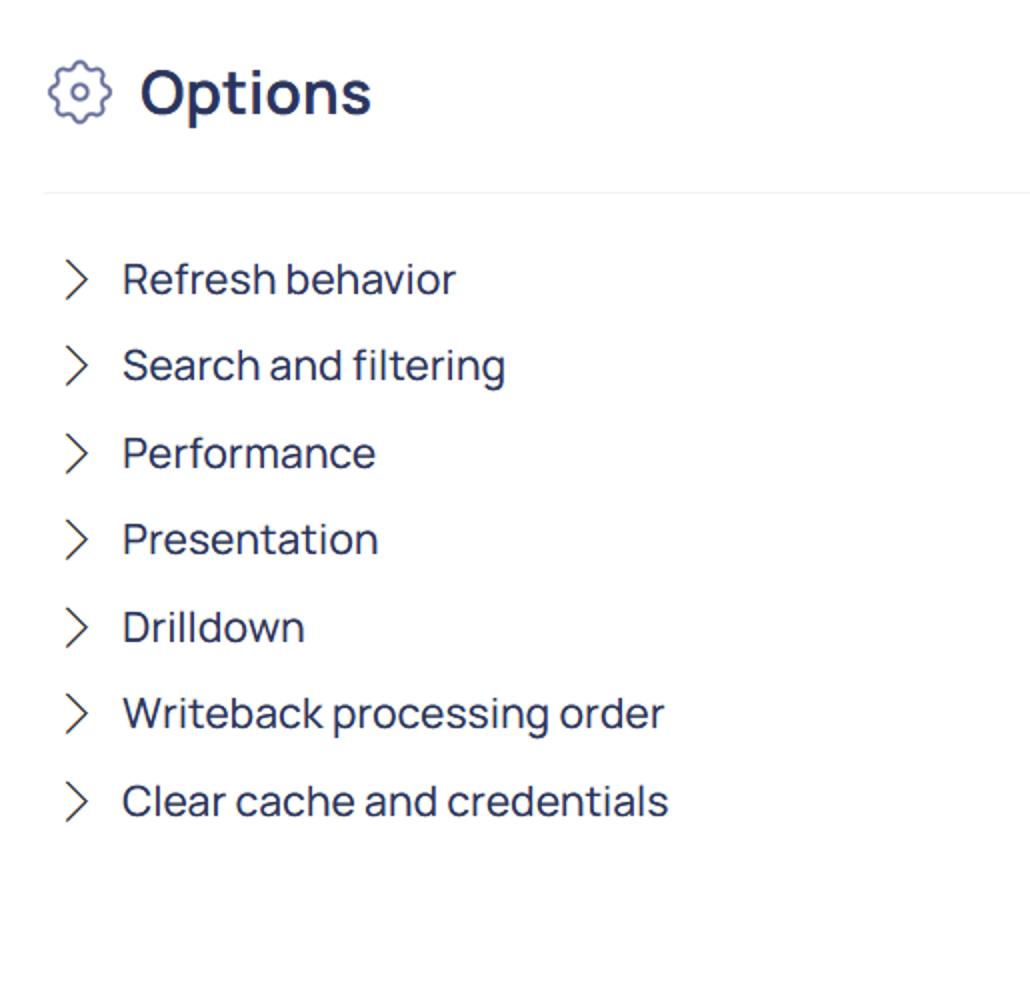
Click the Options button in the Velixo NX Excel menu to summon the Options menu.

Refresh Behavior
-
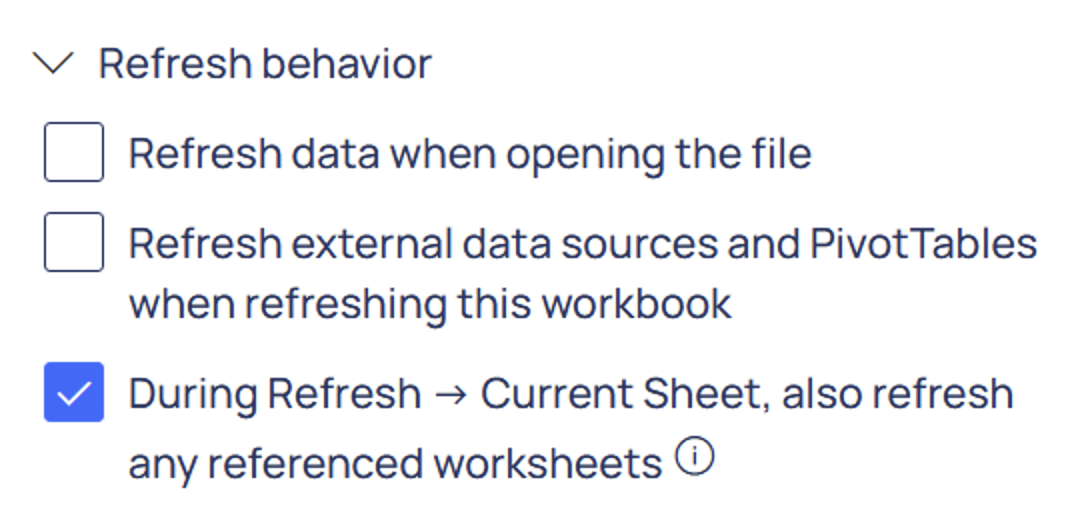
Refresh data when opening the file: When checked, a Smart Refresh will be performed when the workbook is opened (drawing in any data that is new in the ERP since the last refresh of the Velixo functions).
-
Refresh external data sources and PivotTables when refreshing this workbook: When checked, this setting will automatically refresh both PivotTables and non-Velixo external data sources when using the Velixo NX Refresh feature.
-
During Refresh Current Sheet, also refresh any referenced worksheets: When checked (enabled by default), using Refresh Current Sheet will cause the add-in to recursively explore any worksheets referenced by the current sheet and recalculate them first, ensuring that dependent data is up to date before the current sheet is refreshed.
Search and filtering
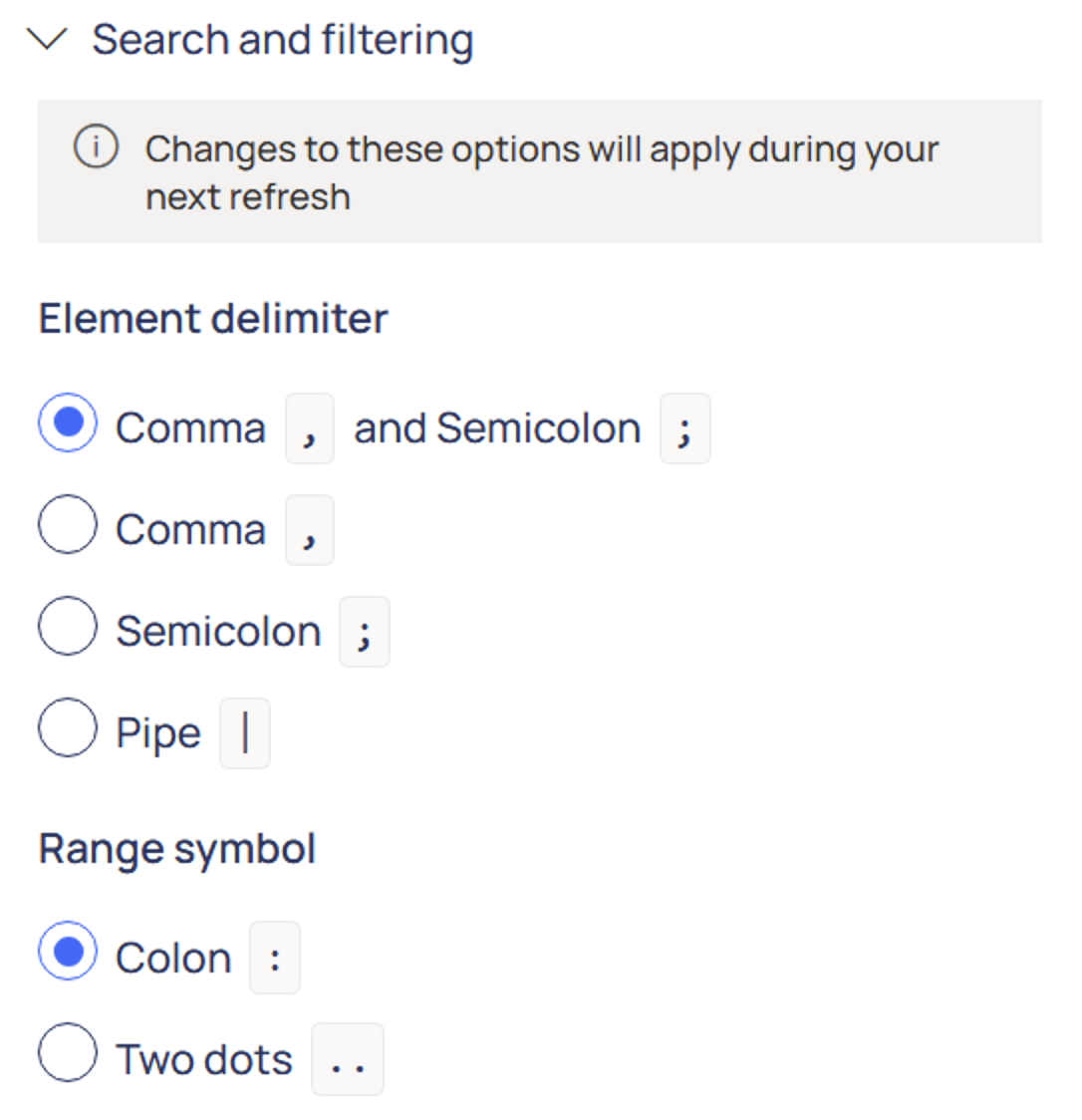
These options control how Velixo range expressions are parsed.
-
Element delimiter: Changes the character used to separate elements in Velixo range expressions. The available options are: Comma and semicolon (default value), Comma, Semicolon, and Pipe (Business Central style).
-
Range symbol: Changes the character used to denote ranges in Velixo range expressions. The available options are: Colon (default value) and Two dots (Business Central style).
Performance
Maximum number of operations per API request in Sage Intacct

This setting controls how many individual operations Velixo bundles into a single API request when communicating with Sage Intacct. The value can be set between 1 and 32, with a default of 16. A higher value reduces the total number of API calls by packing more operations into each request, which can speed up refreshes. However, very large batches may cause the Sage Intacct server to time out on complex or data-heavy operations. If you experience timeout errors during refresh, try lowering this value.
Maximum number of simultaneous REST API requests in Sage Intacct

This setting configures the maximum number of REST API requests that Velixo will send to Sage Intacct simultaneously. The value can be set between 1 and 32, with a default of 4. Adjusting this value may improve refresh performance for workbooks that make many independent data requests, but setting it too high could result in rate limiting from the Sage Intacct API.
Maximum number of simultaneous functions to process
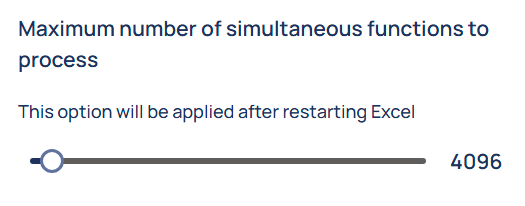
This setting configures the maximum number of functions that Velixo will attempt to evaluate at any time. This can be adjusted to accommodate the resources available on your system.
Options for large Sage Intacct databases

-
Use asynchronous data retrieval. If unchecked, required data will be retrieved from Sage Intacct all at once (regardless of how long it takes). For very large datasets, this can sometimes take long enough for the Sage Intacct server to discontinue the data request. Enabling this option will retrieve the data in several smaller subsets. This will take some extra time, but allow the data to be retrieved.
-
Only load balances for accounts specified in the workbook. If unchecked, all Sage Intacct account balances will be retrieved and cached. This speeds subsequent retrieval of data. For very large charts of accounts, this can take more time than is desired. By enabling this option, balances will be retrieved for ONLY those accounts specifically listed in the workbook.
-
Granular balance loading - an option menu that lets users restrict Velixo ERP balance queries to specific dimensions to reduce the refresh time for large Sage Intacct databases.
-
Global object filters - an option menu that lets users specify filters that will apply to all queries that Velixo makes for any Sage Intacct object.
Presentation
Blank rows in Hide Zero Rows
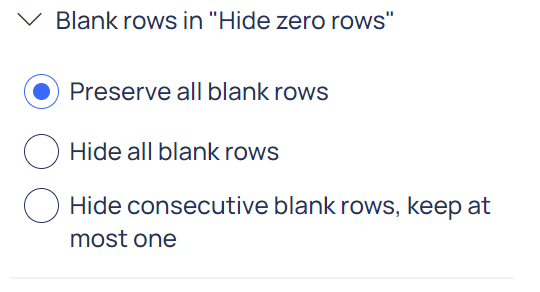
Controls how blank rows/columns should be handled after hiding zero rows/columns in a report. There are three possible settings:
-
Preserve all blank rows (default value): Rows/columns with blank values will remain visible in the report.
-
Hide all blank rows: Blanks will be treated the same as zeros, and those rows/columns will be hidden.
-
Hide consecutive blank rows, keep at most one: All but the first of consecutive blank rows/columns will be hidden; only the first will remain visible in the report.
Missing identifier behavior
This setting determines if Velixo functions will return zero if one or more specified values are not found in the current tenant. This option is useful when creating reports consolidating data from multiple tenants with different configurations. You must refresh your report after changing this option.
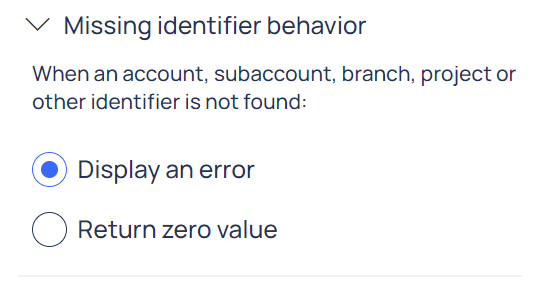
When using the Sage Intacct ERP and referencing an existing account group to which no accounts have been assigned, the Velixo functions will ALWAYS return zero, regardless of the setting of this option.
Drilldown
Sheet destination

Controls whether drilldown sheets are created in the current workbook or if they are created in a separate workbook.
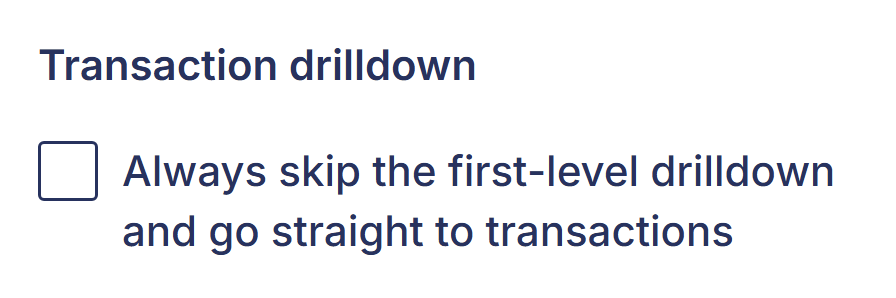
Transaction drilldown
-
Always skip the first-level drilldown and go straight to transactions: When checked, drilling down on a Sage Intacct balance function bypasses the first-level balances sheet and opens a single transaction sheet holding the transactions behind every first-level line. Unchecked by default.
This option's value is saved with the workbook.
Two behaviors do not depend on this option:
-
When the first-level Drilldown resolves to a single summary row, Velixo skips it and opens the transaction sheet anyway.
-
SI.BUDGETTURNOVER shows the first-level sheet even when it resolves to a single row. Checking this option overrides that and opens the transaction sheet.
If no first-level line has a non-zero turnover, Velixo shows the first-level balances sheet instead of an empty transaction sheet.
For the structure of the merged transaction sheet, see Using Drilldown.
Transaction presentation

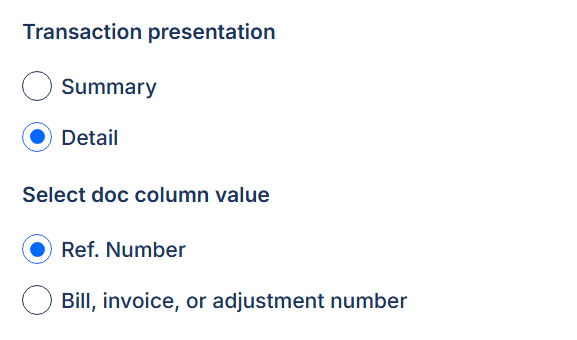
Controls how much detail the transaction Drilldown sheet shows and where the values in its Reference column come from:
-
Summary (default): The Drilldown sheet shows journal entry lines from the
GLENTRYobject. The Reference column shows the line's Doc value, or is empty if the line has none. Bill, invoice, and check numbers and the transaction's reference number appear only under Detail. Select doc column value is disabled, shows no selection, and has no effect on the results. -
Detail: The Drilldown sheet shows lines from the
GLDETAILobject, which also carries the number of each line's source document, such as a bill, invoice, or check. The Reference column follows the Select doc column value setting.
The Reference column matches the Doc column of the Sage Intacct General Ledger report when you run the report with the same Transaction presentation and Select doc column value settings. One known exception is described under Select doc column value.
Select doc column value
This setting is available only when Transaction presentation is set to Detail. It controls which identifier appears in the Reference column when a transaction line has no source document number.
Velixo fills the Reference column of each line using the same order of priority as the Sage Intacct General Ledger report, with one known exception described below:
-
If the line has an information field value, the Reference column shows it. This happens under both options.
-
If the line has no information field value and Ref. Number is selected, the Reference column shows the transaction's reference number.
-
Otherwise, the Reference column is empty.
An information field holds the number of the document behind a line. A line can have more than one information field, for example an AP bill with both a bill number and a reference number. Velixo checks the fields in the order below and shows the first one that has a value:
|
Information field |
Sage Intacct field |
Typical source |
|---|---|---|
|
Doc value on the journal entry line |
|
General journal entries |
|
Invoice or bill number |
|
AR invoices, AP bills |
|
Document, check, or reference number |
|
AP payments, AP bills with a reference number |
The two options work as follows:
-
Bill, invoice, or adjustment number (default): The Reference column shows the line's information field value. The transaction's reference number is never used.
-
Ref. Number: The Reference column shows the line's information field value. If the line has none, the column shows the transaction's reference number. If neither exists, the column is empty.
Behavior difference from the Sage Intacct General Ledger report: when a line has both a bill number and a reference number, for example, an AP bill with both, Velixo shows the bill number under both options. Under Reference number, the Sage Intacct report shows the bill's reference number instead. Under Bill, invoice, or adjustment number, both show the bill number.
Most lines carry an information field, so the two options usually return identical results. They differ only on lines that have no information field value but belong to a transaction with a reference number.
Information fields belong to individual lines, while the reference number belongs to the whole transaction. As a result, lines of the same transaction can show different values. For example, one line can show its Doc value while another line shows the transaction's reference number.
These settings are saved with the workbook. If your organization enforces them in the Velixo Portal, the enforced values apply, and the options are disabled.
Example: the same transaction lines under each option
|
Journal |
Information field value |
Transaction reference number |
Reference column with Bill, invoice, or adjustment number |
Reference column with Ref. Number |
|---|---|---|---|---|
|
|
|
(none) |
|
|
|
|
|
|
|
|
|
|
(none) |
|
(empty) |
|
|
|
(none) |
(none) |
(empty) |
(empty) |
|
|
(none) |
|
(empty) |
|
|
|
|
|
|
|
|
|
|
(none) |
|
|
|
|
|
(none) |
|
|
The second row shows that an information field value takes priority over the reference number under both options. The third and fifth rows are the only ones where the options differ. The fifth and sixth rows are two lines of the same transaction: the line without a Doc value falls back to the reference number under Ref. Number, while the line with a Doc value shows it under both options.
Writeback processing order
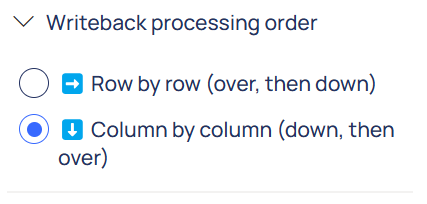
Controls the direction of traversing the worksheet during writeback processing. Options:
-
Row by row (default value): all writeback formulas on the row will be calculated (left to right) before the next row will be calculated.
-
Column by column: all writeback formulas in the column are calculated (top to bottom) before the next column is handled.
Clear cache and credentials
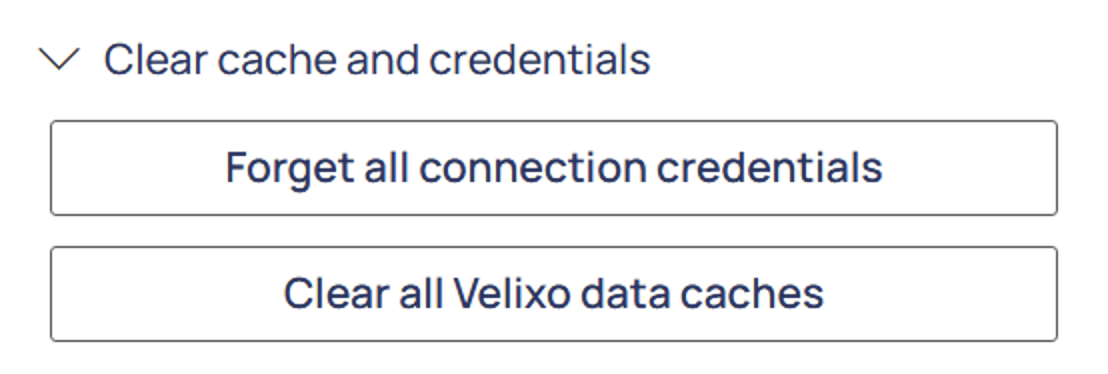
The Forget all connection credentials button allows you to require that new credentials be entered for all connections in the workbook.
Clear all Velixo data caches clears the cache for all connections.